
Before You Enter MAXIM Flash, Read This!
I made it to the Quarterfinals of Maxim Flash. Here's what I learned about how it really works and where up-and-coming photographers can show their work instead.
This Page Used to Ask for Your Vote
For a few weeks, this page asked you to vote for me in Maxim Flash, Maxim's photography competition. A lot of you voted every day, and some of you went further than I ever expected. Thank you, truly.
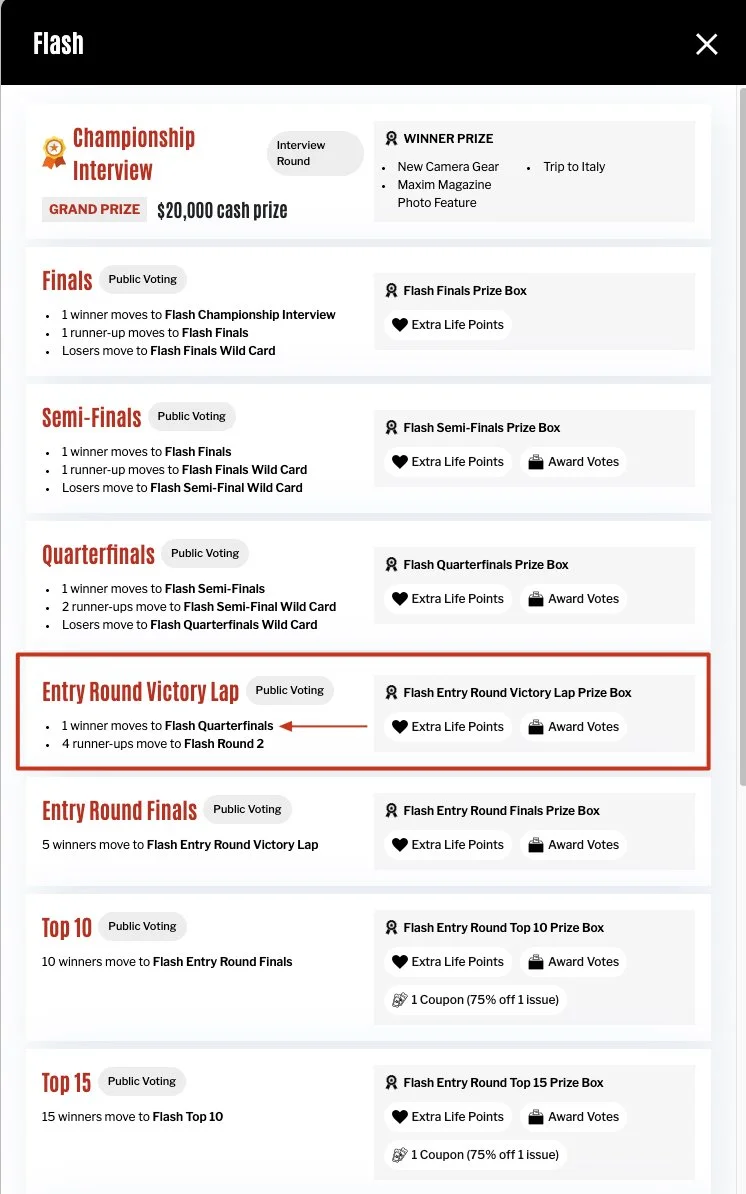
I made it out of the Entry Round, won my Victory Lap, and reached the Quarterfinals. Along the way, it became clear the competition wasn't really measuring photography. So I deleted my account and turned this page into something more useful.
This is for photographers who are where I was a few months ago: talented, hungry, and looking for a place to be seen. Your work deserves a stage that values it, not one that profits from how much your people spend.
How MAXIM Flash Actually Works
Here's the structure, straight from the official rules and my own run-through.
Votes decide almost everything. Votes decide every round, from the first Entry Round through the Finals. Judges score your photography only at the very end, during the Championship Interview.
Free votes are capped. Bought votes aren't. Each person gets one free vote per photographer per day. On top of that, every Maxim Next digital issue someone buys adds votes to the photographer they choose. In my run, each issue added 10.
Photographers can't pay, so their people do. The rules ban competitors from buying their own votes. The money comes from your family, friends, and clients. (They may reimburse them on the side, which can cause them to be inflated)
The rules say purchases don't help. Word for word: "Your Payment and purchases are not required to enter or win any Promotion, and they do not increase your chances to win." Every issue I bought added ten votes to my count.
Losing rarely ends it. Lose a round, and you usually drop into a wild card round. That means another week of asking your people to vote and buy.
When a contest earns more every time your supporters spend, your photography stops being the point. Your audience becomes the product.
The Math That Bothered Me
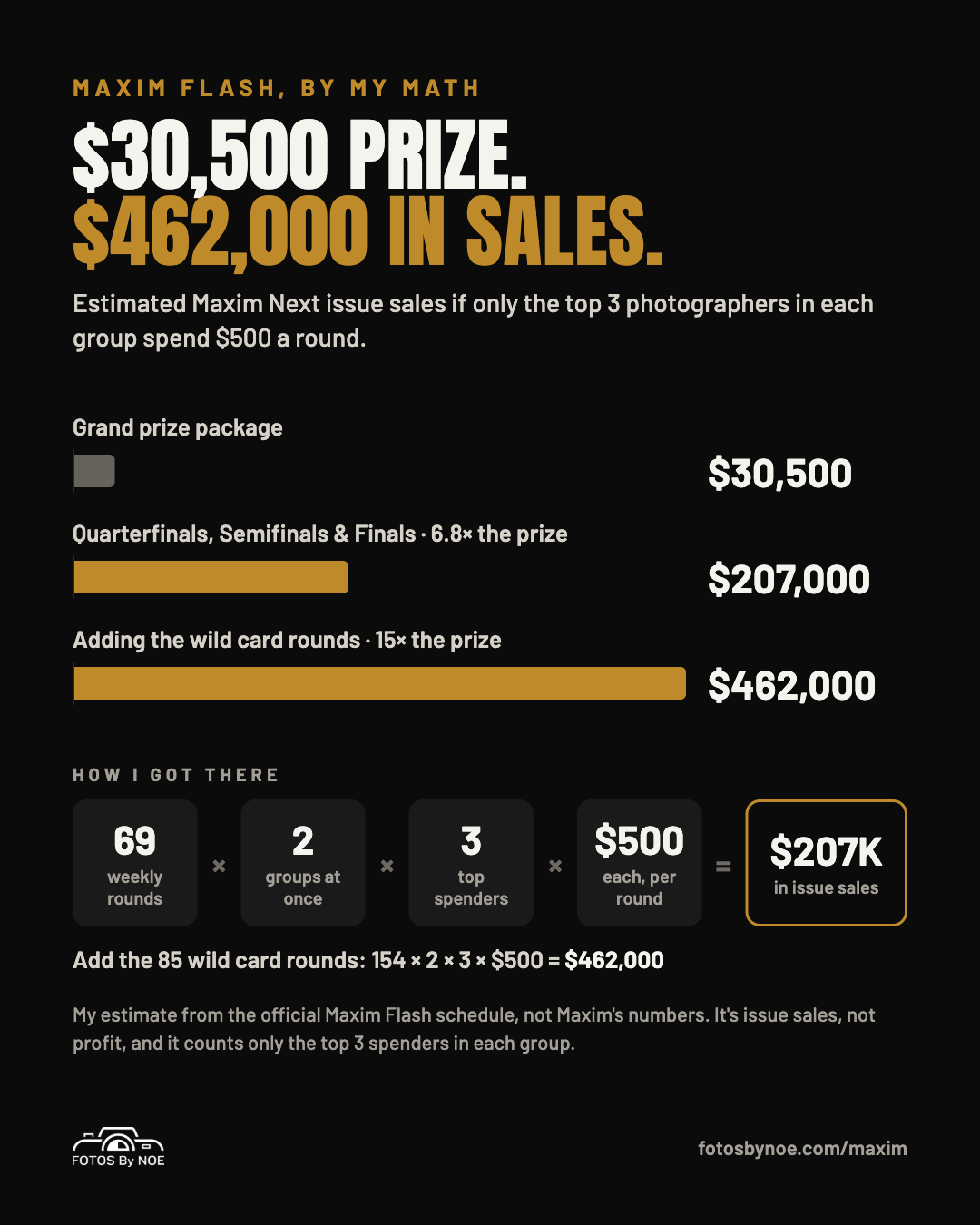
The grand prize package is valued at $30,500: $20,000 cash, $5,000 for new camera gear, a trip to Italy, and a Maxim Magazine feature.
One photographer wins it out of thousands.
From the Quarterfinals on, the official schedule runs about 70 weekly rounds of Quarterfinals, Semifinals and Finals, plus 85 wild card rounds. I saw two Finals groups running at the same time, so I assume two groups per round. Now picture only the top three photographers in each group spending $500 a round, about what went into my Quarterfinals run.
My estimate is on the side, not Maxim's numbers, and it's sales, not profit. But even the lower figure is more than six times the prize, and it counts just three people per group.
Read What You're Agreeing To, Especially Now
What to look for in the fine print:
Perpetual or irrevocable: they can use your work forever, and you can't take it back.
Sublicensable or transferable: they can hand your work to other companies.
Modify or create derivative works: they can change it or build new things from it.
"Any purpose" or commercial use: ads and products, not just promoting the contest.
AI or machine learning: whether your work or data can feed AI systems.
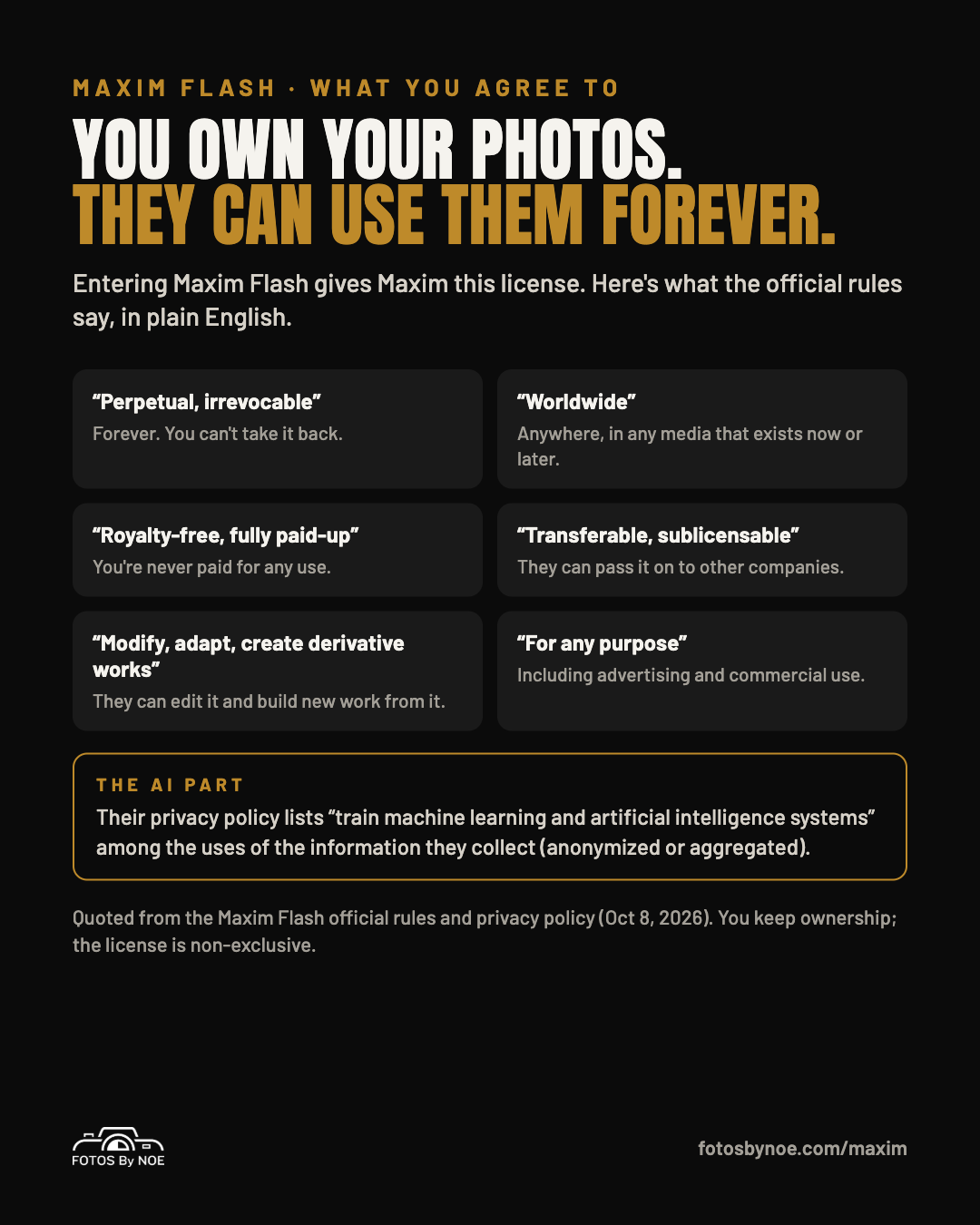
You keep ownership of the photos you enter. But Maxim's official rules grant a license that's about as broad as it gets. It's "worldwide, irrevocable, perpetual, royalty-free, fully paid-up," transferable and sublicensable "through multiple tiers."
That license covers using, modifying, adapting, and creating derivative works from your content "for any purpose," with no further payment to you. If you win, they can also require you to sign a license or assignment of rights to your work.
Their privacy policy also lists "train machine learning and artificial intelligence systems" as one of the ways they may use the information they collect, anonymized or aggregated. That doesn't say your photos train AI. But a license for "any purpose" doesn't rule it out either.
To be fair, broad licenses aren't unique to Maxim. The Smithsonian magazine photo contest takes a "royalty-free, world-wide, perpetual, non-exclusive license" to entries too. That's why the habit matters more than any one contest: read the rights section before you upload anything, anywhere.
How to Spot a Pay-to-Win Contest
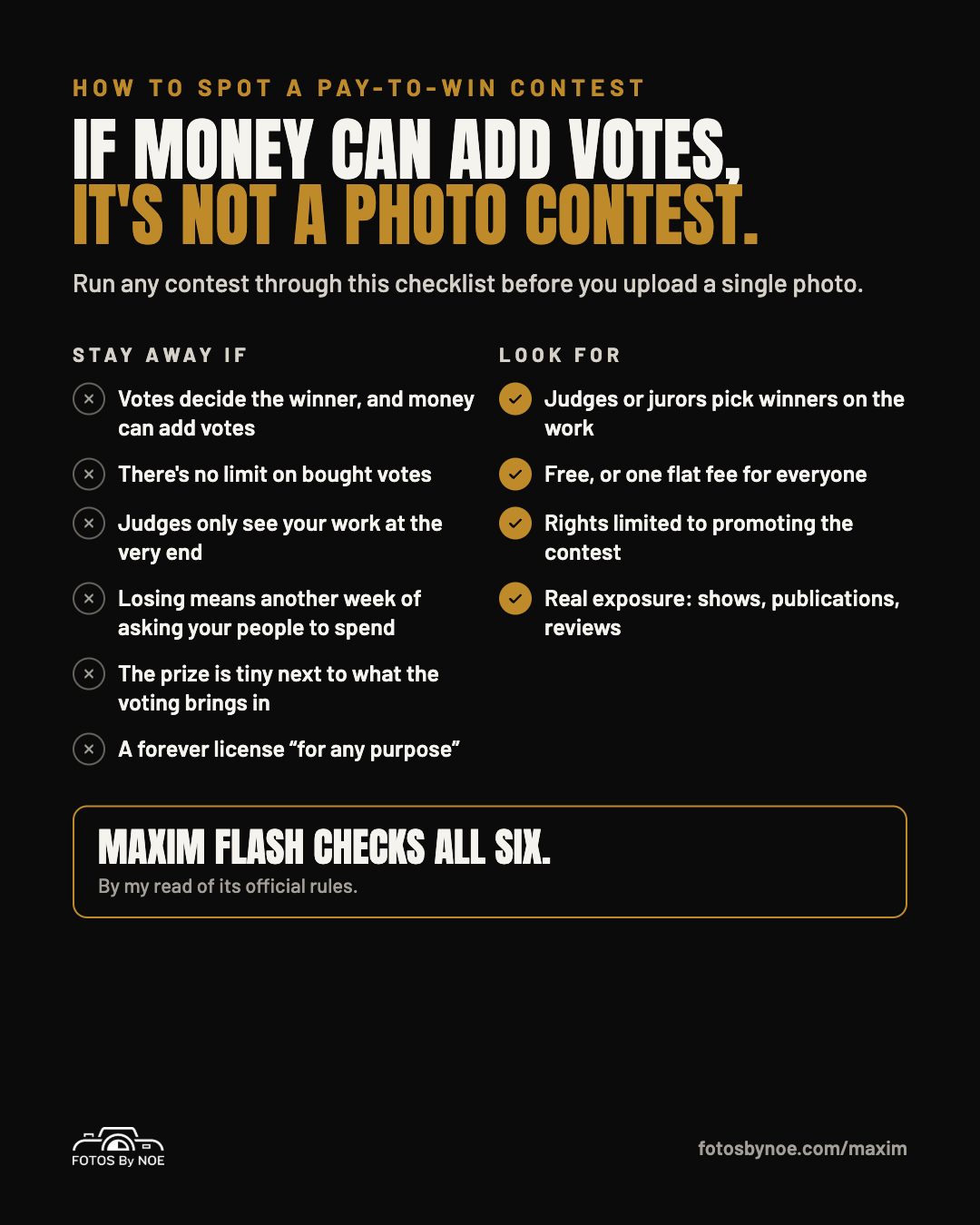
Red flags:
Votes decide the winner, and purchases can add votes.
There's no cap on how many votes money can add.
Judges see the work only at the very end, if at all.
Losing keeps you in for "another chance," and another week of asking your supporters to spend.
The prize is small next to what the voting can bring in.
The rules take a perpetual, sublicensable license "for any purpose."
Green flags:
Judges or jurors pick the winners based on the work.
It's free to enter, or one flat fee that's the same for everyone.
Usage rights are limited to promoting the contest or exhibition.
The exposure is real: exhibitions, publications, portfolio reviews.
If You're Just Starting Out
Your work has value before anyone votes. Build your portfolio, show up for your community, and get paid for your work.
Invest in your craft: Your gear, your education, your clients.
When you enter a competition, pick one where people who know photography actually look at your photos.
Pass This On
If you know a photographer thinking about entering MAXIM Flash or any vote-based contest, send them this page.
If you want to see what I'm building instead, check out my story & see my social media pages from everywhere!